Pallet Flow Racking in Salt Lake City, UT
Salt Lake City's food and beverage distributors depend on pallet flow for FIFO rotation the way any market's food sector would, and we've also built systems for medical device manufacturers in the valley where lot-release schedules drive lane depth instead of expiration dates.
Pallet Flow Racking Solutions for Salt Lake City Warehouses
Utah's capital and largest city, Salt Lake City is the heart of the Wasatch Front industrial corridor. The city's warehousing and distribution sector spans the I-15 and I-80 interchange area, with major logistics hubs in the northwest quadrant near the Salt Lake City International Airport.
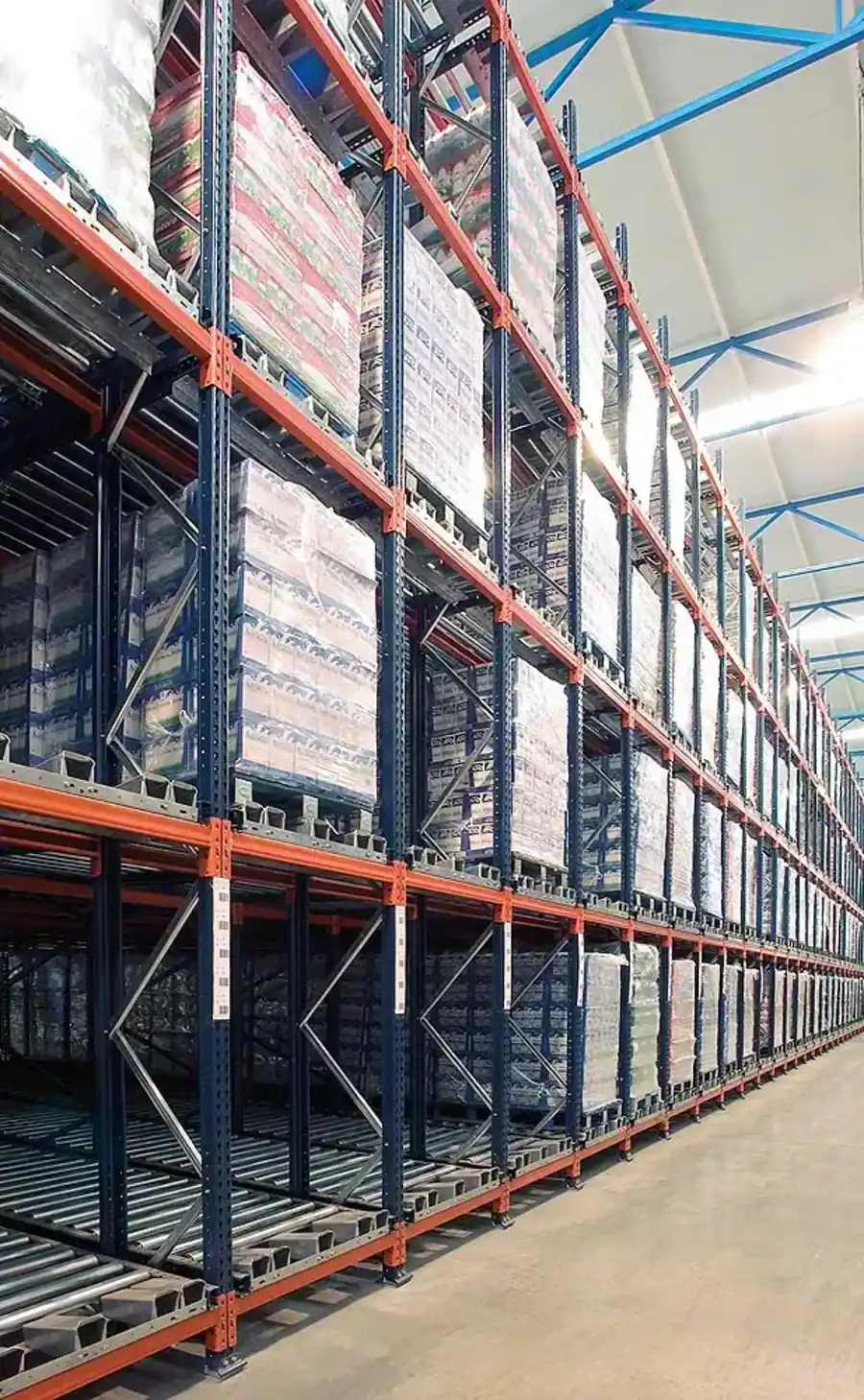
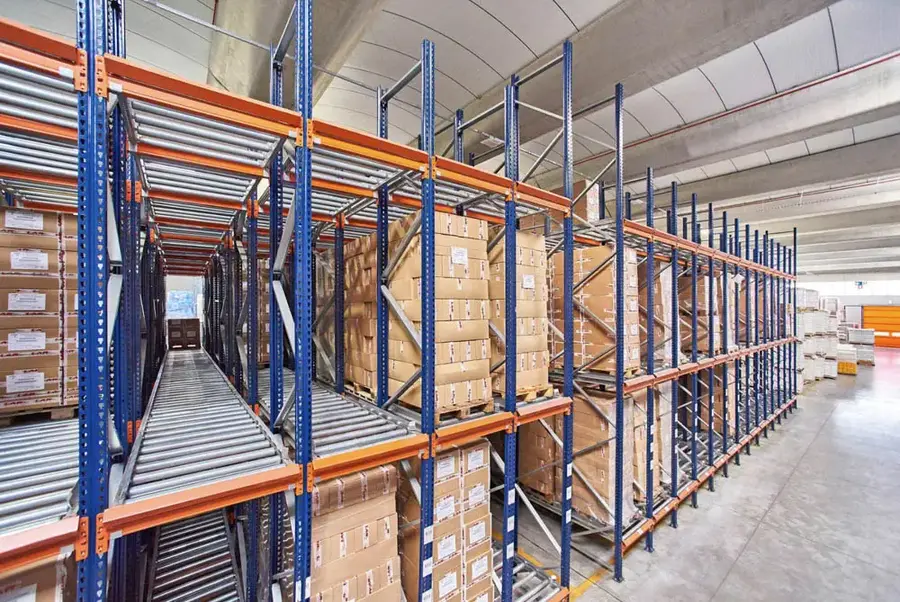
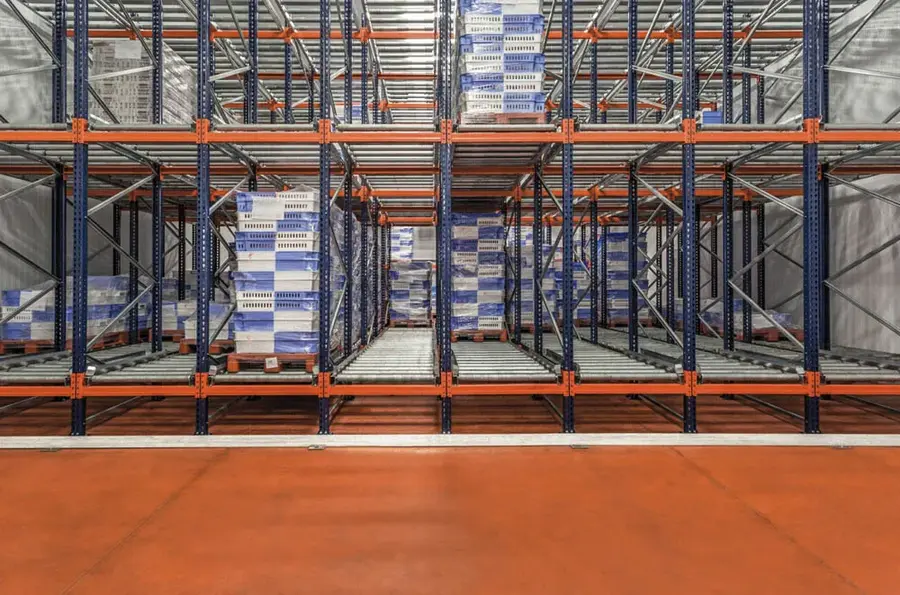
Pallet flow racking, also called pallet live storage, uses a gravity-inclined roller track to move pallets from the load end to the pick end automatically, achieving true first-in, first-out (FIFO) rotation without forklift repositioning. When a pallet is removed from the pick face, gravity moves all remaining pallets in the lane forward automatically, presenting the next pallet to the forklift. This eliminates the deep-lane travel required in drive-in rack systems and creates separate load and pick aisles that improve both safety and efficiency.
Pallet flow is the preferred high-density system for any operation where product rotation matters. Food and beverage distributors, pharmaceutical warehouses, dairy and produce operations, and cold storage facilities all depend on FIFO rotation to manage expiration dates and maintain product quality. In these environments, pallet flow is not just a productivity tool. It is a product quality and compliance tool. Systems are configured in lanes from 2 to 20 or more pallets deep, with multiple lanes per tier and multiple tiers per bay.
Rocky Mountain Warehouse Solutions designs pallet flow systems for facilities across the Mountain West, including freezer and cooler warehouses where high-density FIFO storage provides both operational efficiency and energy cost reduction. Every system includes a layout drawing, lane depth optimization based on your SKU profile and replenishment frequency, and a brake and speed controller specification to ensure pallets travel at a safe, controlled speed from the load end to the pick face.
Salt Lake County: seismic design, permitting, and site conditions
Salt Lake County sits directly over the Salt Lake City segment of the Wasatch fault zone, one of the most active segments in the system, and it also holds the densest concentration of warehouse and distribution square footage in the state. Storage racking here is designed to the higher end of the seismic range we work in, which in practice means engineered base plates, anchor patterns calculated against the actual slab, tighter limits on unbraced upright height, and in taller configurations additional row bracing or a deliberate seismic separation from the building structure.
Site conditions vary more inside this county than buyers expect. The northwest quadrant around the I-80 and I-215 corridors carries a large stock of older industrial buildings where slab thickness, compressive strength, and saw-cut joint layout genuinely constrain anchor selection, while the newer tilt-up development on the west side of the valley generally offers clean slabs and the clear height to justify taller systems. We assess the floor before specifying base plates rather than after, because an anchor that fails an edge-distance check changes the whole base design.
Permitting is administered by Salt Lake County and by the individual municipalities inside it, including Salt Lake City, West Valley City, Sandy, Murray, West Jordan, South Jordan, and Draper, each running its own building department and its own review practice. Thresholds for when a storage rack installation requires a permit and stamped drawings are set at that level, so we confirm with the specific jurisdiction during layout. Our own facility is in Bluffdale, at the south end of the county, so site visits, delivery, and warranty service happen on our own schedule rather than a freight carrier's.
Codes, Compliance, and Enforcement in UT
Utah is a state where storage racking is engineered, not just assembled. Steel storage racks are treated as nonbuilding structures under ASCE 7 with their own design provisions, and much of Utah's warehouse square footage sits in parts of the state where seismic load is a governing design factor rather than a formality. In practice that means engineered base plates, anchor patterns calculated against the actual slab rather than a catalog default, limits on unbraced upright height, and in taller configurations additional row bracing or a deliberate seismic separation from the building structure. How much of that applies depends heavily on where in Utah the facility sits, which is why we work the seismic question at the county and site level rather than quoting a single statewide answer.
Permitting in Utah is local. There is no statewide storage rack permit threshold; county and municipal building departments set their own requirements for when an installation needs a permit, stamped drawings, anchor calculations, and load capacity documentation. Review practice varies noticeably between jurisdictions, so we confirm requirements with the authority having jurisdiction over your specific building during layout rather than after the racking is on site. Slab condition is the input buyers most often overlook: anchor pull-out values depend on concrete depth, compressive strength, and proximity to joints and slab edges, so an older building can drive a different base plate design than a new tilt-up shell in the same city.
Workplace safety enforcement is genuinely statewide. Utah operates its own OSHA-approved State Plan through Utah Occupational Safety and Health, a division of the Utah Labor Commission, rather than relying on federal OSHA. There is no rack-specific OSHA standard anywhere in the country, but storage systems are reachable through general materials handling and storage requirements and the general duty obligation to provide a workplace free of recognized hazards. We design to RMI ANSI MH16.1, provide engineered load capacity labeling on every installation, and retain the anchor, as-built, and inspection documentation that a UOSH inspector, an insurer, or a plan reviewer is likely to ask for.
Technical Specifications & Buying Guide
Pallet flow systems consist of a structural pallet rack frame, typically heavier gauge uprights and beams than standard selective rack to support the additional weight of the flow track hardware and deep pallet loads, and a gravity inclined roller lane at each level. The incline is typically 3/8 to 1/2 inch per foot of lane depth, providing enough gravity force to move loaded pallets at a controlled speed. Roller spacing is set based on pallet type and condition: closer spacing (every 4–6 inches) for damaged pallets or soft-bottom containers, or wider spacing (every 8–12 inches) for block pallets and standard GMA pallets.
Brake controllers are critical components in deep-lane pallet flow systems. Without braking, pallets on a long inclined lane would accelerate to dangerous speeds and impact the pallet stop at the pick face with damaging force. Lane brakes, typically spaced every 4–8 pallet positions, use a ratchet mechanism or weight-activated brake shoe to control pallet speed throughout the lane. Proper brake selection and placement is a key engineering task that ensures pallets arrive at the pick face at a safe, consistent speed regardless of pallet weight or lane depth.
Pallet compatibility is an important operational consideration. GMA pallets (48×40 inches), CHEP blue block pallets, and most standard wooden pallets work well in pallet flow systems. Plastic pallets, Euro pallets, and non-standard pallet sizes may require custom roller configurations or speed control adjustments. In freezer environments, ice formation on rollers and brake mechanisms requires stainless steel components and more frequent inspection to ensure the system functions reliably at sub-zero temperatures.
Key Benefits of Pallet Flow Racking in Salt Lake City
- True FIFO inventory rotation
- Eliminates forklift travel in storage lanes
- Higher density than selective racking
- Separate load and pick aisles improve safety
- Ideal for expiration-date-sensitive products
- Gravity-powered: no electricity required
- Depth from 2 to 20+ pallets
Industries We Serve in Salt Lake City
Food and beverage
Pallet Flow Racking systems tailored for the operational requirements of food and beverage facilities in Salt Lake City.
Pharmaceutical
Pallet Flow Racking systems tailored for the operational requirements of pharmaceutical facilities in Salt Lake City.
Distribution and logistics
Pallet Flow Racking systems tailored for the operational requirements of distribution and logistics facilities in Salt Lake City.
Cold storage
Pallet Flow Racking systems tailored for the operational requirements of cold storage facilities in Salt Lake City.
E-commerce fulfillment
Pallet Flow Racking systems tailored for the operational requirements of e-commerce fulfillment facilities in Salt Lake City.
Manufacturing
Pallet Flow Racking systems tailored for the operational requirements of manufacturing facilities in Salt Lake City.
Common Use Cases in Salt Lake City
Perishable product rotation
Our Salt Lake City installations for perishable product rotation are engineered to perform under real operational conditions, not just spec sheets.
High-velocity replenishment
When Salt Lake City facilities need Pallet Flow Racking for high-velocity replenishment, we provide turnkey solutions that cover design, procurement, installation, and documentation.
Cross-docking operations
Facilities in Salt Lake City use our Pallet Flow Racking systems for cross-docking operations because we deliver configurations that actually match how their operation works.
Cold storage maximization
Pallet Flow Racking systems we install in Salt Lake City for cold storage maximization are sized for your current needs and designed to scale as your operation grows.
Single-SKU deep-lane storage
Our team helps Salt Lake City businesses implement Pallet Flow Racking solutions tailored specifically for single-sku deep-lane storage at any scale.
Why Salt Lake City Businesses Choose Rocky Mountain Warehouse Solutions
From initial design through installation and follow-up inspection, our team manages every step of your Pallet Flow Racking project in Salt Lake City.
As a Mountain West-based company, we serve Salt Lake City with the same speed and attention we give our Utah customers. Local support matters, especially when projects move fast.
Our team has completed Pallet Flow Racking installations in Salt Lake City facilities ranging from 5,000 square feet to over 200,000 square feet. We size and configure every system to match your actual inventory, equipment, and growth plans.
We handle Pallet Flow Racking projects in Salt Lake City from start to finish — layout design, product procurement, delivery coordination, installation, and post-project documentation. You don't need to manage multiple vendors.
Frequently Asked Questions About Pallet Flow Racking in Salt Lake City
What is the difference between pallet flow and push-back racking?
Pallet flow is a FIFO system: pallets load from the rear and pick from the front, using gravity to advance the lane. Push-back is a LIFO system: pallets are pushed back by the next pallet loaded and retrieved from the same front face. Flow is preferred for date-sensitive products; push-back is ideal for large quantities of fewer SKUs where rotation is not critical.
Rocky Mountain Warehouse Solutions serves Salt Lake City, UT and surrounding Salt Lake County businesses. Contact us for local pricing and availability.
Can pallet flow be used in a freezer warehouse?
Yes. Pallet flow is widely used in freezer and cooler warehouses because it maximizes storage density, reducing expensive refrigerated cubic footage, and allows FIFO rotation without forklifts traveling deep into frozen lanes. Freezer applications require stainless steel brake and roller components and more frequent maintenance inspection.
Rocky Mountain Warehouse Solutions serves Salt Lake City, UT and surrounding Salt Lake County businesses. Contact us for local pricing and availability.
How many pallets deep can a pallet flow lane be?
Pallet flow lanes can be 2 to 20+ pallets deep. Practical lane depth depends on your pick frequency. Very deep lanes are efficient for high-volume single-SKU products that are replenished and depleted frequently, but less efficient for slow-moving SKUs where the lane may only turn over once a week.
Rocky Mountain Warehouse Solutions serves Salt Lake City, UT and surrounding Salt Lake County businesses. Contact us for local pricing and availability.
What is a lane brake on a pallet flow system?
A lane brake is a mechanical device that controls pallet speed as it travels down the inclined lane. Without braking, heavy pallets would accelerate to dangerous speeds and impact the front stop with damaging force. Brakes are spaced at intervals throughout the lane to maintain a safe, consistent travel speed from load end to pick face regardless of pallet weight.
Rocky Mountain Warehouse Solutions serves Salt Lake City, UT and surrounding Salt Lake County businesses. Contact us for local pricing and availability.
How do I determine the correct lane depth for my operation?
Lane depth is determined by your replenishment frequency and the number of pallets per SKU you want to hold in the system. A good rule of thumb is to design lanes to hold 1.5 to 2 times your average replenishment quantity, so lanes are never empty before the next replenishment cycle. We model lane depth based on your actual SKU velocities.
Rocky Mountain Warehouse Solutions serves Salt Lake City, UT and surrounding Salt Lake County businesses. Contact us for local pricing and availability.
Which OSHA agency oversees warehouse safety compliance in Utah?
Utah operates its own OSHA-approved State Plan through Utah Occupational Safety and Health (UOSH), a division of the Utah Labor Commission, rather than relying on federal OSHA directly. We design and document every Utah installation to meet UOSH's workplace safety standards.
Get a Free Quote for Pallet Flow Racking in Salt Lake City
Rocky Mountain Warehouse Solutions makes it easy to move forward on Pallet Flow Racking in Salt Lake City. One call gets you a site visit, a layout proposal, and a detailed quote.
Related Products in Salt Lake City
Request a Quote for Pallet Flow Racking in Salt Lake City
Our team can help you choose the right warehouse solution, plan the layout, and move your project forward.
Get a Free Quote