Push-Back Racking in North Salt Lake, UT
A new tenant's SKU count rarely matches what the previous occupant stored in a North Salt Lake building, and push-back gets specified when that count lands somewhere between what selective racking and drive-in each handle cleanly.
Push-Back Racking Solutions for North Salt Lake Warehouses
North Salt Lake sits at the northern gateway to the Salt Lake Valley, with industrial development concentrated along the I-15 corridor. The city's proximity to downtown Salt Lake City and the airport makes it attractive for distribution and logistics operations requiring quick access to the entire Wasatch Front.
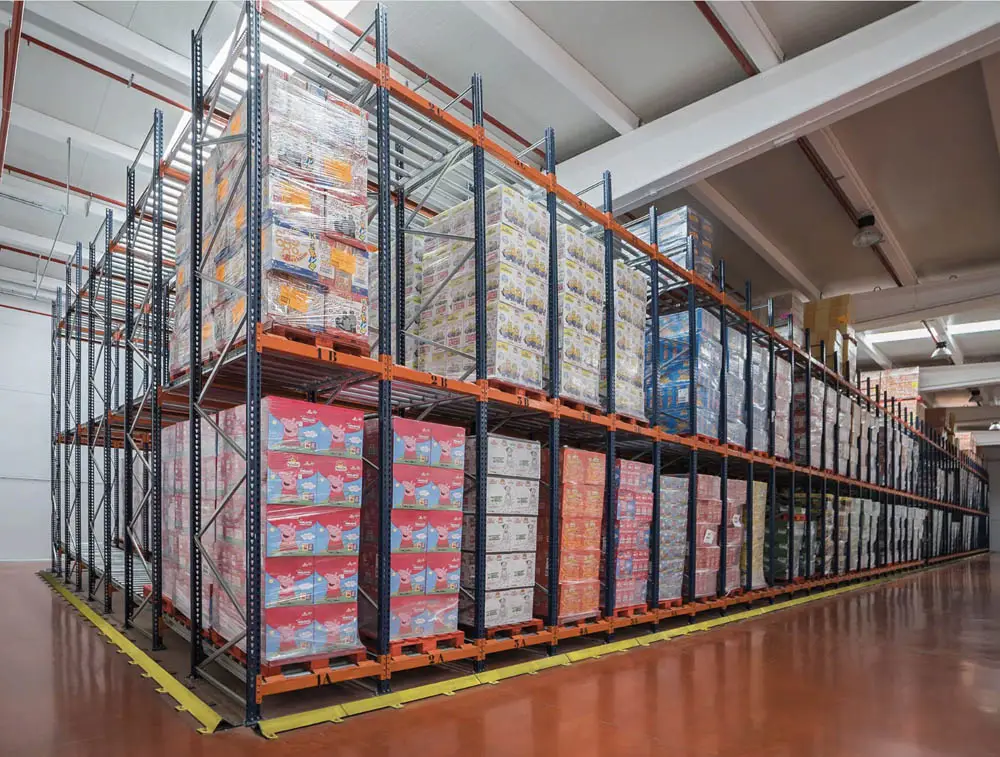
Push-back racking is a last-in, first-out (LIFO) deep-lane system accessed from a single front aisle. Each pallet is placed on a nested cart that rides on inclined rails. As a new pallet is loaded, it pushes the previous pallet back on the rail. When the front pallet is removed, gravity returns the remaining pallets forward to the pick face. Push-back systems handle 2–6 pallet depths and strike a practical balance between storage density and SKU selectivity: better density than selective racking, but better selectivity than drive-in racking: a different SKU can occupy each position in the lane.
For distribution centers and warehouses managing a medium number of high-volume SKUs, push-back racking is often the optimal storage solution. You can dedicate multiple lanes to your highest-velocity products, giving those SKUs deep inventory reserves accessible from a single aisle, while maintaining the flexibility to assign different SKUs to different lanes without the operational constraints of a drive-in system. The result is a storage system that delivers high density and operational flexibility simultaneously.
Rocky Mountain Warehouse Solutions designs and installs push-back racking systems for food and beverage distributors, cold storage facilities, manufacturing operations, and general merchandise warehouses across Utah and the Mountain West. Every system includes an engineered load capacity label, a cart and rail configuration optimized for your pallet type and weight, and installation by our experienced crews. We also service existing push-back systems, replacing worn carts, damaged rails, and bent components.
Davis County: defense logistics documentation and Wasatch Front seismic
Davis County runs along the I-15 corridor between Salt Lake City and Ogden and sits over the Wasatch fault zone, so racking here carries the same seismic design expectations as the rest of the Front: engineered anchorage, base plate calculations tied to the specific slab, and bracing appropriate to the upright height rather than a generic configuration.
What sets Davis County apart is documentation. Hill Air Force Base and the surrounding defense logistics operations, along with the concentration of contractors in and around the Freeport Center in Clearfield, mean a large share of facilities here work under government contract requirements. Those customers routinely need audit-ready records rather than just working hardware: preventive maintenance schedules, inspection sign-offs, engineered load capacity labeling, and retained anchor and as-built documentation. We build that into the project from the first installation instead of assembling it later when a contract review asks for it, because reconstructing it after the fact is considerably harder.
Permitting runs through Davis County and the individual cities including Layton, Clearfield, Bountiful, Kaysville, Farmington, and North Salt Lake. Requirements and review practice differ between them, so we verify with the jurisdiction that covers your facility during layout rather than carrying a Salt Lake County assumption north.
Codes, Compliance, and Enforcement in UT
Utah is a state where storage racking is engineered, not just assembled. Steel storage racks are treated as nonbuilding structures under ASCE 7 with their own design provisions, and much of Utah's warehouse square footage sits in parts of the state where seismic load is a governing design factor rather than a formality. In practice that means engineered base plates, anchor patterns calculated against the actual slab rather than a catalog default, limits on unbraced upright height, and in taller configurations additional row bracing or a deliberate seismic separation from the building structure. How much of that applies depends heavily on where in Utah the facility sits, which is why we work the seismic question at the county and site level rather than quoting a single statewide answer.
Permitting in Utah is local. There is no statewide storage rack permit threshold; county and municipal building departments set their own requirements for when an installation needs a permit, stamped drawings, anchor calculations, and load capacity documentation. Review practice varies noticeably between jurisdictions, so we confirm requirements with the authority having jurisdiction over your specific building during layout rather than after the racking is on site. Slab condition is the input buyers most often overlook: anchor pull-out values depend on concrete depth, compressive strength, and proximity to joints and slab edges, so an older building can drive a different base plate design than a new tilt-up shell in the same city.
Workplace safety enforcement is genuinely statewide. Utah operates its own OSHA-approved State Plan through Utah Occupational Safety and Health, a division of the Utah Labor Commission, rather than relying on federal OSHA. There is no rack-specific OSHA standard anywhere in the country, but storage systems are reachable through general materials handling and storage requirements and the general duty obligation to provide a workplace free of recognized hazards. We design to RMI ANSI MH16.1, provide engineered load capacity labeling on every installation, and retain the anchor, as-built, and inspection documentation that a UOSH inspector, an insurer, or a plan reviewer is likely to ask for.
Technical Specifications & Buying Guide
Push-back racking uses a series of nesting carts (typically 2 carts for a 3-deep system, 3 carts for a 4-deep system, and so on) that stack on top of each other at the front of the lane when empty. Each cart rides on inclined rails attached to the pallet rack beams, sloped at approximately 3/8 inch per foot toward the pick face. When a pallet is placed on the front cart, the operator pushes it back to place it behind the front position, nesting the carts together. Each subsequent pallet loads behind the previous one. When the front pallet is retrieved, the remaining carts and pallets flow forward under gravity to the pick face.
Cart capacity is a critical specification. Standard push-back carts are rated for 2,500–3,500 lbs per pallet position for 2–3 deep systems. Heavy-duty carts for 4–6 deep systems with heavier loads require structural-grade cart components and heavier rail sections. The incline angle and cart design must be carefully matched: too shallow an incline and pallets may not return to the pick face reliably; too steep and pallets arrive with excessive speed. Properly engineered push-back systems from Unarco, Mecalux, or other reputable manufacturers account for these variables across a range of pallet weights.
The operational advantage of push-back versus drive-in is significant in multi-SKU environments. In a drive-in lane, only one SKU can occupy the lane (any retrieval requires taking the front pallet, which may not be the desired SKU unless the lane is dedicated to a single product). In push-back racking, the front pallet is always the most recently loaded, meaning a single lane can contain multiple pallets of the same SKU loaded at different times, or in some warehouse configurations, different SKUs if LIFO rotation is acceptable for those products. The front-only access from a single aisle also means no sacrificial aisle is needed at the back of the system, recovering that floor space for additional storage.
Key Benefits of Push-Back Racking in North Salt Lake
- Better SKU selectivity than drive-in racking
- Single-aisle access from the front only
- LIFO rotation for non-date-sensitive products
- 2–6 pallet depths available
- Gravity-powered return: no electricity needed
- Works with standard counterbalance forklifts
- Higher density than selective racking
Industries We Serve in North Salt Lake
Food and beverage
Push-Back Racking systems tailored for the operational requirements of food and beverage facilities in North Salt Lake.
Distribution and logistics
Push-Back Racking systems tailored for the operational requirements of distribution and logistics facilities in North Salt Lake.
Manufacturing
Push-Back Racking systems tailored for the operational requirements of manufacturing facilities in North Salt Lake.
Cold storage
Push-Back Racking systems tailored for the operational requirements of cold storage facilities in North Salt Lake.
Retail distribution
Push-Back Racking systems tailored for the operational requirements of retail distribution facilities in North Salt Lake.
E-commerce fulfillment
Push-Back Racking systems tailored for the operational requirements of e-commerce fulfillment facilities in North Salt Lake.
Common Use Cases in North Salt Lake
Medium to high volume SKU storage
We design and install Push-Back Racking configurations built for the demands of medium to high volume sku storage in North Salt Lake warehouses.
Cold storage density improvement
Our team helps North Salt Lake businesses implement Push-Back Racking solutions tailored specifically for cold storage density improvement at any scale.
Non-perishable product bulk storage
Push-Back Racking systems we install in North Salt Lake for non-perishable product bulk storage are sized for your current needs and designed to scale as your operation grows.
Reducing forklift aisle count
Facilities in North Salt Lake use our Push-Back Racking systems for reducing forklift aisle count because we deliver configurations that actually match how their operation works.
Transitional inventory buffer
When North Salt Lake facilities need Push-Back Racking for transitional inventory buffer, we provide turnkey solutions that cover design, procurement, installation, and documentation.
Why North Salt Lake Businesses Choose Rocky Mountain Warehouse Solutions
We don't subcontract our North Salt Lake installations. Your project is handled by our own ANSI/RMI-certified crews, start to finish.
Our ANSI/RMI-certified crews have installed Push-Back Racking systems in hundreds of Mountain West facilities, including many in North Salt Lake and the surrounding region.
Not all Push-Back Racking suppliers understand the Mountain West market. Rocky Mountain Warehouse Solutions is built around it — we know the facilities, the contractors, and the code requirements across the region including North Salt Lake.
Our North Salt Lake project timeline is built around your schedule. We phase installations when needed to keep your operation running, and our crews work efficiently to minimize disruption.
Frequently Asked Questions About Push-Back Racking in North Salt Lake
What is the load capacity per level for push-back racking?
Push-back systems are typically rated for 2,500 to 3,500 lbs per pallet position for standard 2–3 deep configurations. Heavy-duty systems for 4–6 deep lanes can support 3,500–5,000 lbs depending on the cart and rail specification. We provide engineered load capacity labels for every installation.
Rocky Mountain Warehouse Solutions serves North Salt Lake, UT and surrounding Davis County businesses. Contact us for local pricing and availability.
Is push-back racking compatible with my existing forklifts?
Push-back racking works with standard counterbalance and reach-truck forklifts. The key requirements are that the forklift mast height accommodates your storage height and the lift capacity supports your heaviest loaded pallet. We verify forklift compatibility as part of the quoting process and can provide mast and capacity recommendations.
Rocky Mountain Warehouse Solutions serves North Salt Lake, UT and surrounding Davis County businesses. Contact us for local pricing and availability.
How does push-back racking compare to drive-in for density?
Drive-in racking provides slightly higher storage density than push-back because there are no cart and rail components occupying vertical space. However, push-back provides much better SKU selectivity and eliminates the need for forklifts to drive inside the rack structure, which reduces operational risk and column damage.
Rocky Mountain Warehouse Solutions serves North Salt Lake, UT and surrounding Davis County businesses. Contact us for local pricing and availability.
What pallets work best in push-back racking?
Standard GMA 48×40 wooden pallets work well in most push-back systems. Block pallets (CHEP, plastic block pallets) are also compatible. String pallets and poorly conditioned pallets with missing boards or cracked runners can cause cart engagement issues. We recommend inspecting and discarding damaged pallets before using them in push-back systems.
Rocky Mountain Warehouse Solutions serves North Salt Lake, UT and surrounding Davis County businesses. Contact us for local pricing and availability.
Can push-back carts be repaired if damaged?
Yes. Individual carts and rail sections can be replaced without rebuilding the entire system. We carry common cart components for major push-back manufacturers and can source replacement parts for older systems. Cart and rail inspection should be part of your annual rack inspection program to identify wear or impact damage before it affects system performance.
Rocky Mountain Warehouse Solutions serves North Salt Lake, UT and surrounding Davis County businesses. Contact us for local pricing and availability.
Which OSHA agency oversees warehouse safety compliance in Utah?
Utah operates its own OSHA-approved State Plan through Utah Occupational Safety and Health (UOSH), a division of the Utah Labor Commission, rather than relying on federal OSHA directly. We design and document every Utah installation to meet UOSH's workplace safety standards.
Get a Free Quote for Push-Back Racking in North Salt Lake
Don't let storage constraints limit your North Salt Lake operation. Push-Back Racking from Rocky Mountain Warehouse Solutions is a proven, cost-effective solution — contact us to get started.
Related Products in North Salt Lake
Request a Quote for Push-Back Racking in North Salt Lake
Our team can help you choose the right warehouse solution, plan the layout, and move your project forward.
Get a Free Quote