Shelving in Casper, WY
Boltless shelving built for light parts storage doesn't survive long in a Casper energy company's maintenance crib, where dropped tools and oily equipment call for a heavier steel gauge from the start.
Shelving Solutions for Casper Warehouses
Casper is Central Wyoming's largest city and the hub of Wyoming's energy industry, positioned along I-25 in the heart of the Powder River Basin. The city's industrial base is anchored by oil and gas operations, with supporting distribution and manufacturing facilities serving a large rural region.
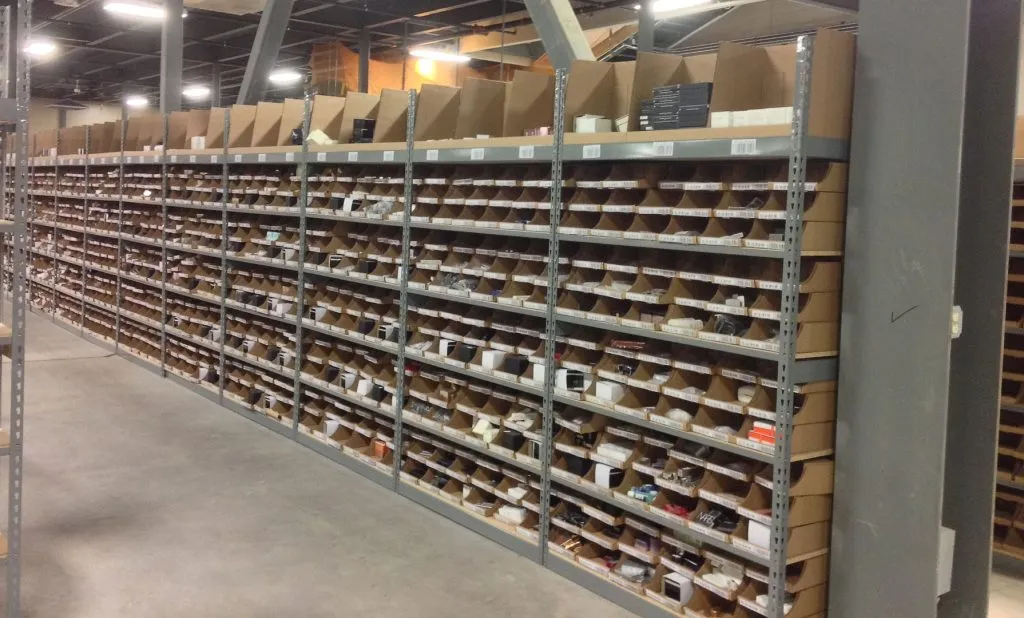
Industrial shelving bridges the gap between pallet racking and standard office shelving, providing heavy-duty, height-adjustable storage for parts, small items, tools, files, and products that are too small or light for a pallet rack bay. We supply boltless rivet shelving for parts and small items, wire shelving for food-grade and visibility applications, heavy-duty steel shelving for parts rooms and maintenance areas, and wide-span shelving for bulky items that are too small for pallet rack but too large for standard shelving. All systems are height-adjustable, easy to assemble, and available in a range of load ratings and footprint sizes.
The versatility of industrial shelving makes it a fixture in nearly every type of facility. A distribution center uses shelving in the small-parts pick area alongside pallet racking in the bulk storage area. A manufacturing plant relies on heavy-duty shelving in the maintenance crib for spare parts and tooling. A hospital supply room stores medical supplies and equipment on wire shelving that meets NSF food-service and healthcare standards. A government facility uses evidence-grade shelving in the records management room. The right shelving system for each application depends on load requirements, item dimensions, access frequency, and regulatory requirements.
Rocky Mountain Warehouse Solutions supplies shelving as standalone units, in configured systems, or as part of complete facility storage projects alongside pallet racking, mezzanines, and other systems. We help you select the right shelving type, configure the layout, and install the system, whether it is a single shelving unit for a break room or a multi-aisle shelving system for a 50,000 square foot stockroom.
The most common shelving mistake is buying by shelf dimension rather than by duty rating and load type. Two systems that look identical on a spec sheet can differ by a factor of five in capacity per shelf, and the difference only becomes visible when a beam deflects or a unit racks under load. We specify from what you actually store, how it is handled, and whether the environment involves temperature swings, washdown, or freezer conditions, because those factors change decking, finish, and connection type more than shelf size ever does.
Codes, Compliance, and Enforcement in WY
Wyoming's seismic hazard varies more across the state than almost anywhere else we serve. The northwest corner around Jackson and the Yellowstone region carries substantial seismic design load, while Cheyenne, Casper, and Laramie sit in comparatively low-hazard territory where seismic is rarely the governing factor in a racking design. Because the difference is large and the state is wide, we design from the specific site rather than from a statewide assumption.
What consistently governs Wyoming projects instead is load type. The energy sector moves heavier, bulkier, and more irregular freight than a typical distribution operation, which pushes projects toward structural rather than roll-formed components, higher-capacity cantilever arms, and vehicle restraints and dock levelers rated for larger trucks than a standard freight dock sees. Wind and winter conditions matter for any outdoor or yard storage, and hot-dip galvanized systems are frequently the right specification rather than an upgrade. Evanston's position between Salt Lake City and the Wyoming interior means facilities there often handle both standard palletized freight and oversized energy equipment across the same dock, which is a sizing problem rather than a product-selection one.
Workplace safety in Wyoming is administered by the Wyoming Occupational Safety and Health Administration, housed within the Wyoming Department of Workforce Services, rather than by federal OSHA. We build and document every Wyoming installation to those state-enforced standards and to RMI ANSI MH16.1. Permitting is handled at the county and municipal level, and in the less densely regulated parts of the state the review can be lighter than buyers expect, which makes engineered load capacity labeling and retained anchor documentation more important rather than less.
Technical Specifications & Buying Guide
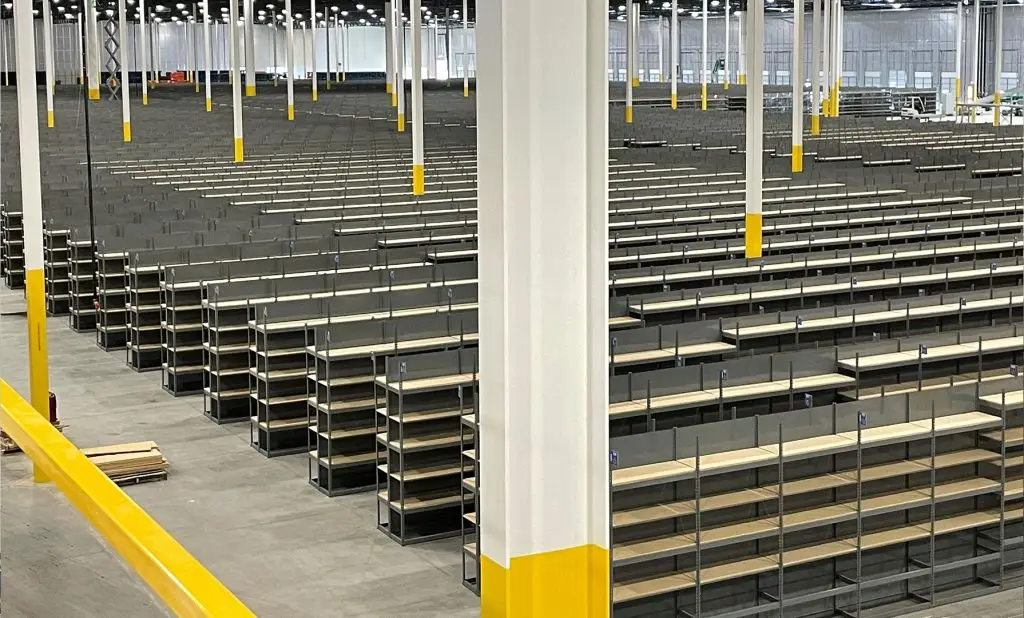
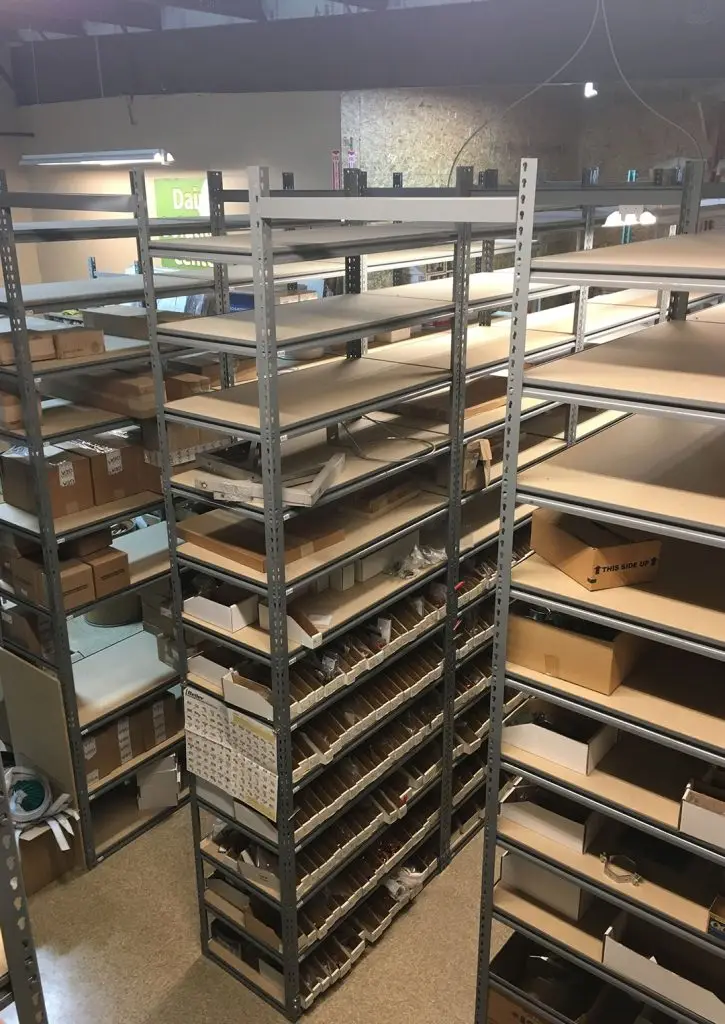
Boltless rivet shelving, also called clip shelving or longspan shelving, is the most common type for general parts and box storage. The beams snap into vertical uprights via a rivet connector that requires no tools to assemble or adjust. Shelf capacity ranges from 350 lbs per shelf for light-duty versions to 2,000 lbs per shelf for heavy-duty wide-span versions. Shelf height is adjustable in 1.5-inch increments. Standard bay widths are 36, 48, and 72 inches; depths are 12, 18, 24, and 30 inches. For very long items, wide-span shelving in 96-inch and 144-inch widths is available with heavier structural tube uprights and heavy-duty beams.
Wire shelving uses a welded wire grid shelf surface supported on chrome or epoxy-coated steel poles. The open wire design provides maximum air circulation, water drainage (important for walk-in coolers), and visibility. NSF-listed wire shelving meets strict standards for food-contact and food-proximity storage environments and is required in commercial kitchen, food storage, and healthcare supply areas. Shelf capacity typically ranges from 200 to 800 lbs per shelf for standard configurations. Wire shelving poles accept shelf clips at 1-inch increments, providing very fine height adjustment.
Heavy-duty steel shelving uses thicker-gauge steel shelves (typically 18 or 16-gauge) with a formed channel or reinforced deck for maximum rigidity. It is used in parts cribs, maintenance areas, and tool rooms where items may be heavy, oily, or dropped onto shelves without consideration. Steel shelves are available with particle board or steel decking, and cabinets can be configured with doors (hinged or sliding) for dust protection and security. Mobile shelving (also called compact shelving or high-density shelving) mounts shelving units on rolling carriages that eliminate the aisle between every row, storing the same inventory in 40–50% of the floor space required by conventional shelving.
Industrial shelving divides into a few structurally distinct families. Boltless or rivet shelving uses beams that lock into keyhole slots in the upright and typically carries 500 to 3,000 lbs per shelf depending on beam profile and decking, assembling without fasteners and reconfiguring quickly. Steel clip shelving uses closed or open posts with clip-in shelves and suits smaller parts and higher shelf density. Wide-span shelving bridges the gap between shelving and pallet racking, carrying heavier loads across longer beam spans for bulky, hand-loaded items. Selecting between them is a function of unit load weight, whether items are placed by hand or by equipment, and how often the configuration changes. Published capacities always assume a uniformly distributed load; a concentrated load in the center of a shelf can exceed the rated moment at well under the stated weight.
Decking choice affects capacity, fire protection, and serviceability. Particle board is the least expensive and suits light dry goods; steel decking carries more and survives impact; wire decking allows sprinkler water penetration and is frequently required by fire code above certain storage heights or commodity classifications. Environment drives the rest of the specification. Cold and freezer storage change adhesive and coating behavior and can rule out particle board entirely. Washdown environments in food processing require finishes and connection details that tolerate repeated cleaning without corroding at the joints. High-humidity or outdoor-adjacent areas favor galvanized over painted finish. In seismic design categories common across much of our service area, tall shelving runs need anchorage and sometimes overhead restraint, since a loaded shelving unit is a tipping hazard well before it is a structural one.
Key Benefits of Shelving in Casper
- No tools required for assembly (boltless)
- Height-adjustable in 1.5-inch increments
- Wide range of weight capacities
- Wire options for food-grade compliance
- Easy to reconfigure as needs change
- Compatible with mobile shelving carriage systems
- Powder-coated finish for durability
Industries We Serve in Casper
Retail and wholesale
Shelving systems tailored for the operational requirements of retail and wholesale facilities in Casper.
Parts and maintenance
Shelving systems tailored for the operational requirements of parts and maintenance facilities in Casper.
Healthcare
Shelving systems tailored for the operational requirements of healthcare facilities in Casper.
Food service
Shelving systems tailored for the operational requirements of food service facilities in Casper.
Government and military
Shelving systems tailored for the operational requirements of government and military facilities in Casper.
Manufacturing
Shelving systems tailored for the operational requirements of manufacturing facilities in Casper.
Common Use Cases in Casper
Parts and MRO storage
From layout planning to final installation, we deliver Shelving optimized for parts and mro storage in Casper.
File and archive storage
Rocky Mountain Warehouse Solutions specializes in Shelving for file and archive storage, serving facilities across Casper and the Mountain West.
Small-parts order picking
Casper warehouses relying on Shelving for small-parts order picking benefit from our engineered layouts and expert installation.
Tool and equipment storage
We design and install Shelving configurations built for the demands of tool and equipment storage in Casper warehouses.
Retail back-of-house
Our team helps Casper businesses implement Shelving solutions tailored specifically for retail back-of-house at any scale.
Evidence and records management
Shelving systems we install in Casper for evidence and records management are sized for your current needs and designed to scale as your operation grows.
Why Casper Businesses Choose Rocky Mountain Warehouse Solutions
We understand Mountain West warehouse conditions — seismic zones, temperature swings, high-clearance facilities — and design every Shelving system in Casper accordingly.
We offer free warehouse layout assessments for Casper facilities — our team visits your site, measures your space, and delivers a proposed configuration before you commit to anything.
Whether your Casper operation runs one shift or three, Shelving systems from Rocky Mountain Warehouse Solutions are built to handle the throughput demands of active warehouse environments.
Every Shelving project we complete in Casper follows the same proven process: site assessment, engineered layout design, permit coordination if required, professional installation, load capacity labeling, and a final safety inspection.
Frequently Asked Questions About Shelving in Casper
What is the difference between boltless and bolted shelving?
Boltless shelving uses a rivet or clip connection that requires no hardware. Beams press into the upright, making assembly fast and allowing easy height adjustment. Bolted shelving uses nuts and bolts at every connection and is heavier-duty for applications requiring maximum rigidity and the highest load capacity per shelf.
Rocky Mountain Warehouse Solutions serves Casper, WY and surrounding Natrona County businesses. Contact us for local pricing and availability.
Can shelving be used in food storage areas?
Yes. NSF-listed wire shelving is approved for food storage environments, with the open wire design providing air circulation, easy cleaning, and visibility into stored product. Solid steel shelving can be used in non-direct-food-contact areas with appropriate cleaning protocols. We specify the right shelving type based on your food safety requirements.
Rocky Mountain Warehouse Solutions serves Casper, WY and surrounding Natrona County businesses. Contact us for local pricing and availability.
What is wide-span shelving and when do I need it?
Wide-span shelving uses bays 72–144 inches wide with heavier structural members to span the longer distance without sagging. It is used for items too large for standard 36–48 inch bays but not large enough for pallet racking. Common applications include automotive parts, engine blocks, HVAC units, and large boxed equipment.
Rocky Mountain Warehouse Solutions serves Casper, WY and surrounding Natrona County businesses. Contact us for local pricing and availability.
Can shelving be integrated with pallet racking in the same facility?
Yes. In most distribution and warehouse facilities, pallet racking handles bulk pallet storage while shelving handles small-parts, individual-carton, or piece-pick inventory. The two systems complement each other and can be installed in adjacent areas or integrated into a pick module. We design facilities with both systems as needed.
Rocky Mountain Warehouse Solutions serves Casper, WY and surrounding Natrona County businesses. Contact us for local pricing and availability.
What is mobile shelving and how much space does it save?
Mobile shelving (compact shelving) mounts rows on rolling carriages that move laterally on floor tracks, allowing the aisle to be positioned anywhere in the system rather than having a permanent aisle between every row. This typically saves 40–50% of the floor space required for the same storage capacity on conventional fixed shelving. It is widely used for records, evidence, and high-value compact storage.
Rocky Mountain Warehouse Solutions serves Casper, WY and surrounding Natrona County businesses. Contact us for local pricing and availability.
How much does industrial shelving cost?
Shelving price is driven by duty rating, decking type, and height rather than by shelf count alone. Light-duty boltless units for dry goods sit at the low end, while heavy-duty wide-span systems with steel decking, taller uprights, and seismic anchorage cost substantially more per linear foot. The variables that move a quote are capacity per shelf, beam span, decking material, finish or coating requirements, and whether the installation needs anchoring and engineered documentation. We publish ranges during the quoting process and size from what you actually store, because a system specified for 500 lbs per shelf and one specified for 2,500 lbs are different products even at identical dimensions.
Rocky Mountain Warehouse Solutions serves Casper, WY and surrounding Natrona County businesses. Contact us for local pricing and availability.
What is the difference between shelving and pallet racking?
The dividing line is how the load is placed. Shelving is designed for hand-loaded or cart-loaded items, with shelf levels close enough together to reach and capacities sized for individual cartons, bins, and parts. Pallet racking is designed for unit loads placed and retrieved by a forklift, with beam levels spaced for pallet height and capacities in the thousands of pounds per pair. If a forklift will place the load, you want racking. If a person will, you want shelving. Wide-span shelving occupies the middle ground for bulky items that are hand-loaded but too heavy or awkward for standard shelving.
Rocky Mountain Warehouse Solutions serves Casper, WY and surrounding Natrona County businesses. Contact us for local pricing and availability.
How much weight can heavy-duty industrial shelving hold?
Capacity depends on beam profile, beam span, upright gauge, and decking. Typical boltless industrial shelving is rated from 500 to 3,000 lbs per shelf level, and wide-span systems extend well beyond that. Every published rating assumes the load is uniformly distributed across the shelf; concentrated loads placed in the center of a span reduce effective capacity significantly. Longer beam spans always reduce capacity per shelf, which is why widening a bay to save on uprights often costs more capacity than it saves in material. We provide load capacity information for every installation so the rating is documented rather than assumed.
Rocky Mountain Warehouse Solutions serves Casper, WY and surrounding Natrona County businesses. Contact us for local pricing and availability.
Can industrial shelving be used in cold storage or washdown areas?
Yes, with the right specification. Cold and freezer environments affect adhesives, coatings, and decking behavior, and particle board decking is generally inappropriate. Washdown areas in food and beverage processing require finishes and connection details that tolerate repeated cleaning and sanitation chemicals without corroding at the joints, which usually points toward galvanized or specialized coated systems rather than standard powder coat. We specify against the actual environment rather than adapting a dry-goods configuration, because the failure mode in these settings is corrosion at connections rather than overload.
Rocky Mountain Warehouse Solutions serves Casper, WY and surrounding Natrona County businesses. Contact us for local pricing and availability.
Who enforces workplace safety standards for warehouses in Wyoming?
Wyoming operates its own OSHA-approved State Plan through the Wyoming Occupational Safety and Health Administration (Wyoming OSHA), housed within the Wyoming Department of Workforce Services, rather than federal OSHA. We build every Wyoming installation to meet those state-enforced standards.
Get a Free Quote for Shelving in Casper
Contact us today to discuss your Shelving needs in Casper. We'll help you find the right configuration, the right timeline, and the right price for your project.
Related Products in Casper
Request a Quote for Shelving in Casper
Our team can help you choose the right warehouse solution, plan the layout, and move your project forward.
Get a Free Quote