Cantilever Racking in Albuquerque, NM
Albuquerque's aerospace manufacturers often store long aluminum extrusions and structural bar stock that need cantilever's full-length access rather than a pallet rack's fixed beam spacing, while regional building-materials distributors along the I-25/I-40 corridor need outdoor-rated galvanized systems for lumber and pipe stored in open yards.
Cantilever Racking Solutions for Albuquerque Warehouses
Albuquerque is New Mexico's largest city and the commercial hub of the Southwest, positioned at the junction of I-25 and I-40. The city's industrial base spans aerospace and defense, food processing, distribution, and a growing technology sector, with major logistics operations serving the broader Four Corners region.
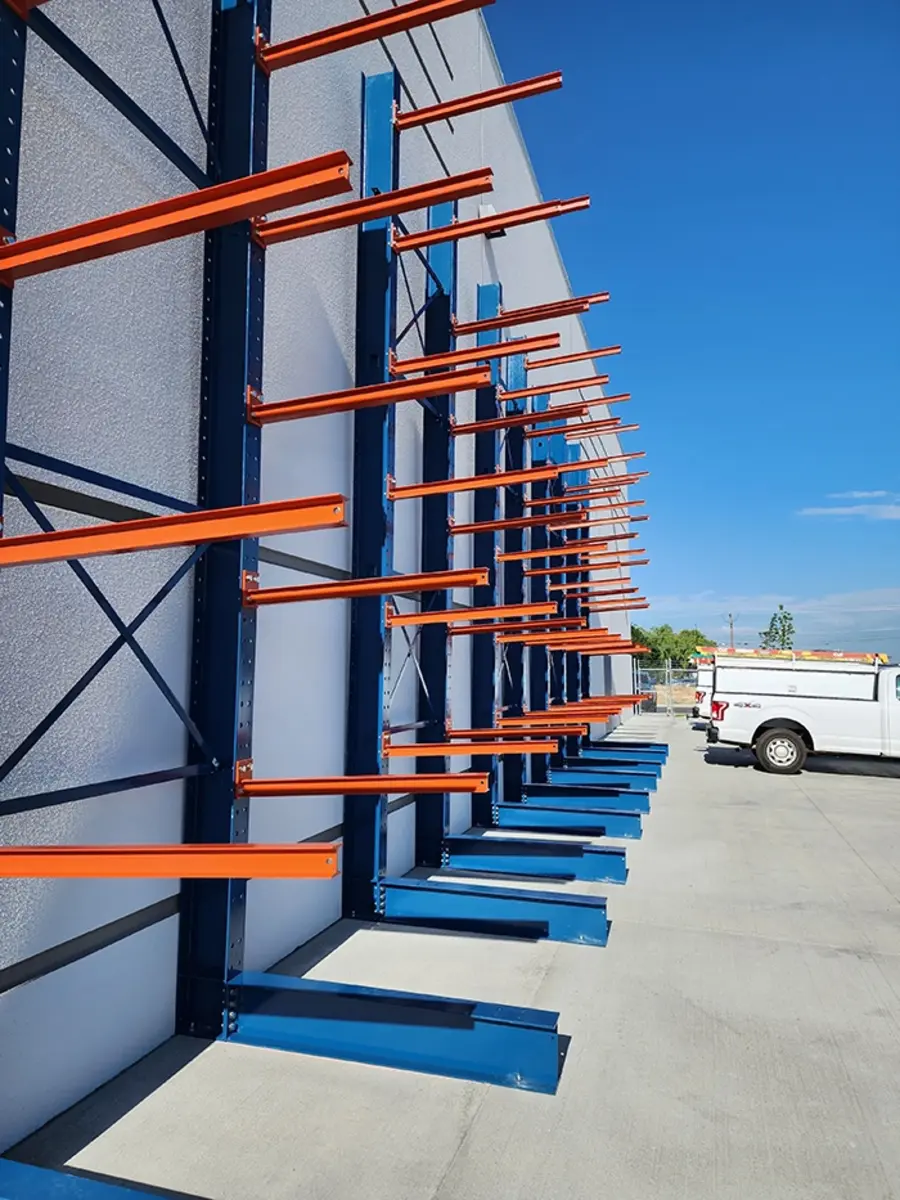
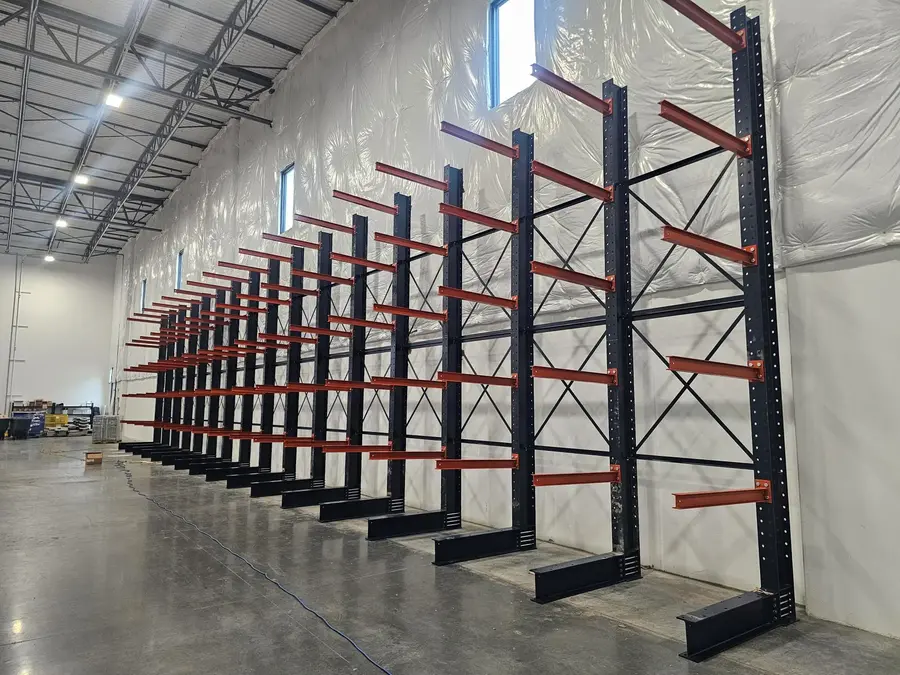
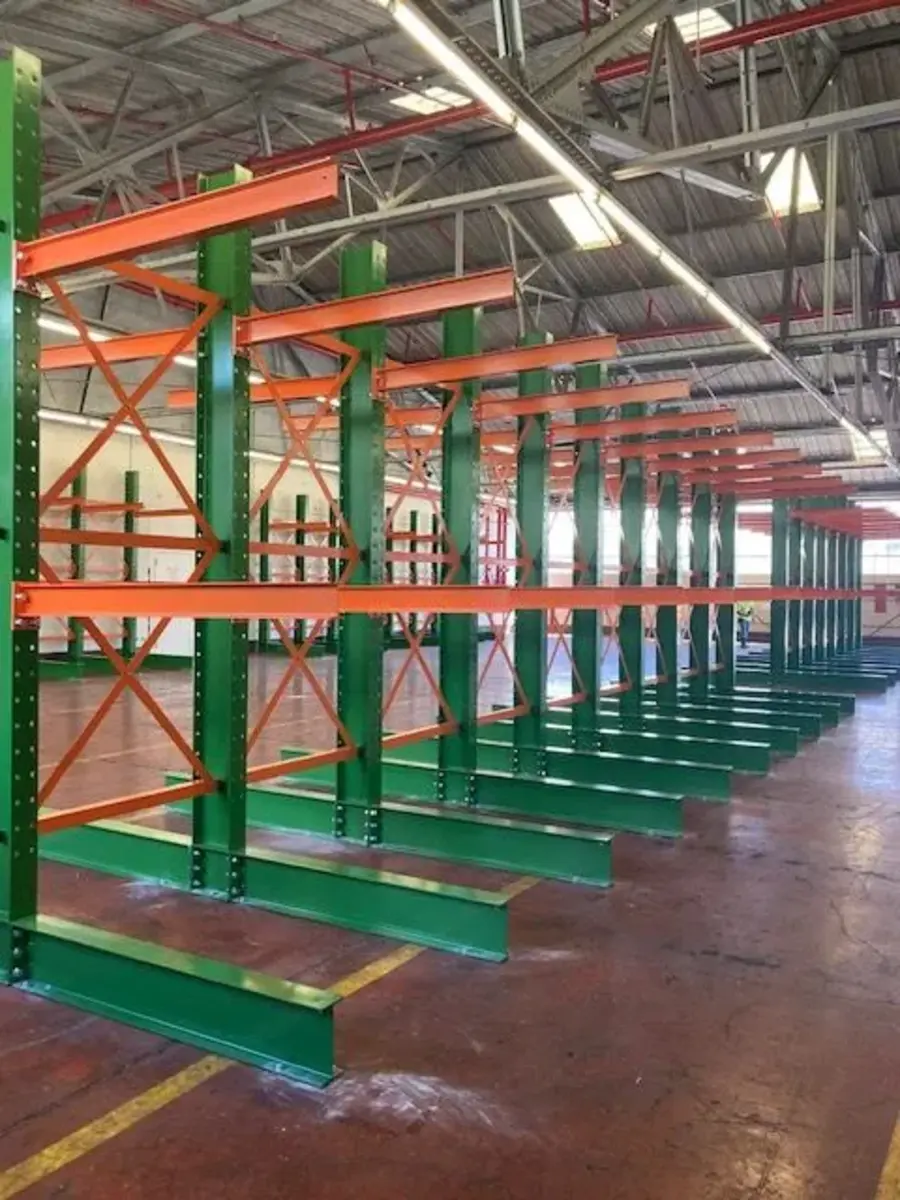
Cantilever racking is purpose-built for storing materials that do not fit on standard pallet rack: long lengths of pipe, tubing, lumber, bar stock, sheet metal, and furniture. Without vertical column obstructions between storage positions, cantilever arms provide full-length access to materials of any size. Our systems feature heavy-duty steel columns, adjustable arms at 3-inch increments, and optional brace sets for seismic zones. Available in single-sided and double-sided configurations from light-duty through structural grade, cantilever racking is the definitive solution for long material storage challenges.
The adjustability of cantilever systems makes them ideal for facilities storing a wide variety of material lengths and profiles. Arms can be repositioned at any time without tools. Simply adjust the arm spacing to accommodate lumber bundles of different lengths, or reconfigure a bay entirely when your product mix changes. Double-sided configurations allow loading and picking from both sides of the aisle, maximizing storage density in facilities with sufficient material depth on each side.
Rocky Mountain Warehouse Solutions designs cantilever systems for building materials distributors, steel service centers, lumber yards, plumbing supply houses, furniture warehouses, and industrial manufacturing plants throughout the Mountain West. Every project includes a layout drawing, load capacity engineering, and installation by our experienced crews. Outdoor galvanized systems are also available for open-yard applications.
Choosing cantilever comes down to three numbers: the heaviest single load you will place on one arm, the longest material you need to support, and the total weight you will carry per upright. Those drive arm capacity, arm length, and column selection respectively, and getting them in the wrong order is the most common way a cantilever quote comes back wrong. We size from your actual material list rather than from a catalog configuration, because a lumber yard storing 16-foot dimensional stock and a steel service center storing 20-foot bar have almost nothing in common structurally even though both are buying cantilever.
Codes, Compliance, and Enforcement in NM
New Mexico's seismic hazard comes from the Rio Grande rift, the extensional zone running roughly north to south through the center of the state and directly through the Albuquerque metropolitan area. The hazard is moderate rather than severe, well below the Wasatch Front but meaningfully above the Phoenix basin, which means seismic anchoring and base plate design are a real part of an Albuquerque racking specification without dominating the budget the way they can in Utah or northern Nevada.
Elevation and climate shape the rest. Albuquerque sits above 5,000 feet with wide daily temperature swings, which affects dock seal and shelter specification for refrigerated freight and the duty expectations on hydraulic dock equipment. The city's position at the intersection of I-25 and I-40 has drawn growing e-commerce fulfillment operations alongside an established food and beverage processing base, and those two profiles want different equipment: fulfillment runs daily trailer counts that justify hydraulic levelers over mechanical, while processors need thermal envelope performance and washdown-compatible components. Aerospace and defense manufacturing in the region adds custom platform and equipment-frame work that falls outside standard product configurations.
Workplace safety in New Mexico is administered by the Occupational Health and Safety Bureau, part of the New Mexico Environment Department, rather than by federal OSHA. We design and document every New Mexico installation to OHSB standards and to RMI ANSI MH16.1. Permitting is handled locally through Bernalillo County and the City of Albuquerque, and storage rack permit thresholds and drawing requirements are set at that level, so we confirm them with the building department during layout.
Technical Specifications & Buying Guide
Cantilever racking is specified by column height, arm length, arm capacity, and base configuration. Light-duty roll-formed cantilever is rated from 500 to 2,000 lbs per arm and is suitable for lighter products like furniture, PVC pipe, and aluminum extrusions. Heavy-duty structural cantilever uses hot-rolled steel arms and columns rated from 2,000 to 8,000+ lbs per arm for heavy steel bar, structural lumber, and industrial pipe. Column heights typically range from 8 to 20 feet, with arm lengths from 18 to 48 inches for standard systems and custom lengths available for special applications.
Single-sided cantilever is anchored to a wall or freestanding with a braced base, storing material on one face only. Double-sided systems are freestanding with a shared column and arms extending in both directions, effectively doubling storage capacity per row of columns. Double-sided systems require adequate floor anchor points for stability and are designed for the combined load of both arm faces. For facilities in Utah and other Mountain West states with seismic requirements, brace kits and anchor bolt engineering are included as standard on systems above a certain height and load threshold.
Load distribution across arms is an important design consideration. Material should be stored on a minimum of three arms to prevent point loading and potential arm deflection. When storing material that is shorter than the total bay width, dividers or arm stops prevent material from sliding to one end. For mixed-length storage, tapered arm configurations or adjustable arm supports allow efficient use of the full column height. Our design team accounts for all of these factors in the layout and specification process.
The capacity math is where most cantilever specifications go wrong. Arm capacity and upright capacity are separate ratings, and satisfying one does not satisfy the other. An upright rated at 12,000 lbs total does not support six arms each rated at 4,000 lbs; the column rating is the ceiling for everything hung on it, and it decreases as arm length increases because a longer arm applies more bending moment at the connection. Arm capacity itself is published at a specific load position, usually assuming a uniformly distributed load rather than a point load at the arm tip. A concentrated load placed at the end of an arm can exceed the rated moment even when the total weight is well under the published number.
Arm spacing is driven by material deflection, not by convenience. The general rule is that material should span a minimum of three arms so the load distributes and cannot tip or rack the system, which means arm spacing has to be set from the shortest material you intend to store, not the longest. Flexible material such as thin-wall tube, small-diameter pipe, or long lumber may need four or more arms to prevent sag between supports. Base depth governs stability: a taller upright carrying longer arms needs a deeper base to resist overturning, and the required depth increases in higher seismic design categories, where anchorage into the slab becomes a structural requirement rather than a recommendation. In seismic regions across our service area we design cantilever anchorage explicitly rather than treating it as an accessory, and outdoor installations add wind loading to the same calculation.
Key Benefits of Cantilever Racking in Albuquerque
- No vertical obstructions: full-length material access
- Adjustable arm heights at 3-inch increments
- Single and double-sided configurations
- Light duty through structural grade
- Seismic bracing available for Mountain West installations
- Outdoor-rated galvanized systems available
- Custom arm lengths and capacities
Industries We Serve in Albuquerque
Building materials
Cantilever Racking systems tailored for the operational requirements of building materials facilities in Albuquerque.
Steel service centers
Cantilever Racking systems tailored for the operational requirements of steel service centers facilities in Albuquerque.
Lumber and millwork
Cantilever Racking systems tailored for the operational requirements of lumber and millwork facilities in Albuquerque.
Plumbing supply
Cantilever Racking systems tailored for the operational requirements of plumbing supply facilities in Albuquerque.
Manufacturing
Cantilever Racking systems tailored for the operational requirements of manufacturing facilities in Albuquerque.
Furniture distribution
Cantilever Racking systems tailored for the operational requirements of furniture distribution facilities in Albuquerque.
Common Use Cases in Albuquerque
Lumber and plywood storage
Our team helps Albuquerque businesses implement Cantilever Racking solutions tailored specifically for lumber and plywood storage at any scale.
Pipe, tube, and bar stock
We design and install Cantilever Racking configurations built for the demands of pipe, tube, and bar stock in Albuquerque warehouses.
Sheet metal and flat stock
Albuquerque warehouses relying on Cantilever Racking for sheet metal and flat stock benefit from our engineered layouts and expert installation.
Furniture and cabinet storage
Rocky Mountain Warehouse Solutions specializes in Cantilever Racking for furniture and cabinet storage, serving facilities across Albuquerque and the Mountain West.
HVAC duct and equipment
From layout planning to final installation, we deliver Cantilever Racking optimized for hvac duct and equipment in Albuquerque.
Automotive bumpers and trim
We configure Cantilever Racking systems that solve real automotive bumpers and trim challenges for Albuquerque operations of every size.
Why Albuquerque Businesses Choose Rocky Mountain Warehouse Solutions
Rocky Mountain Warehouse Solutions has completed over 500 projects and installed over 1,200 systems across the Mountain West, including Albuquerque and the surrounding region.
We offer free warehouse layout assessments for Albuquerque facilities — our team visits your site, measures your space, and delivers a proposed configuration before you commit to anything.
Our team has completed Cantilever Racking installations in Albuquerque facilities ranging from 5,000 square feet to over 200,000 square feet. We size and configure every system to match your actual inventory, equipment, and growth plans.
Every Cantilever Racking project we complete in Albuquerque follows the same proven process: site assessment, engineered layout design, permit coordination if required, professional installation, load capacity labeling, and a final safety inspection.
Frequently Asked Questions About Cantilever Racking in Albuquerque
What materials can cantilever racking store?
Cantilever racking is ideal for any long, bulky, or irregularly shaped material: lumber, pipe, tube, bar stock, sheet metal, plywood, furniture, HVAC duct, and similar items that do not fit on standard pallet rack beams. It excels anywhere the material length exceeds what a pallet rack beam can reliably support.
Rocky Mountain Warehouse Solutions serves Albuquerque, NM and surrounding Bernalillo County businesses. Contact us for local pricing and availability.
What is the difference between light-duty and structural cantilever?
Light-duty cantilever uses roll-formed steel arms and columns, typically rated to 800–2,000 lbs per arm. Structural cantilever uses hot-rolled structural steel and is rated for 2,000–8,000+ lbs per arm, suitable for heavy steel bar, dense lumber, and heavy industrial pipe storage.
Rocky Mountain Warehouse Solutions serves Albuquerque, NM and surrounding Bernalillo County businesses. Contact us for local pricing and availability.
Can cantilever racking be used outdoors?
Yes. We offer hot-dip galvanized cantilever systems rated for outdoor use. These are popular for lumber yards, building material distributors, pipe storage yards, and any facility where material is stored outside under an open canopy or in fully exposed conditions.
Rocky Mountain Warehouse Solutions serves Albuquerque, NM and surrounding Bernalillo County businesses. Contact us for local pricing and availability.
How many arms does material need to span?
Material should span a minimum of three arms to distribute the load properly and prevent tipping or deflection. For shorter items, arm spacing can be reduced. For very long items like 40-foot structural steel, arm spacing is set to provide adequate support points along the full length.
Rocky Mountain Warehouse Solutions serves Albuquerque, NM and surrounding Bernalillo County businesses. Contact us for local pricing and availability.
Can I adjust cantilever arms without removing the load?
Arms should be adjusted only when unloaded. The adjustment process is simple: lift the arm slightly to disengage from the column pin and reposition at the desired height. The 3-inch increment adjustment allows precise height settings to match your material profile.
Rocky Mountain Warehouse Solutions serves Albuquerque, NM and surrounding Bernalillo County businesses. Contact us for local pricing and availability.
How much does cantilever racking cost?
Cantilever pricing is driven by duty rating far more than by size. Light-duty roll-formed systems are the least expensive per linear foot of storage, while heavy structural systems with long arms and deep bases can cost several times as much for the same footprint. The variables that move a quote most are arm capacity, arm length, upright height, base depth, whether the system is single or double-sided, and whether it needs galvanizing for outdoor use or engineered seismic anchorage. Because those combinations vary so widely, we quote from your material list and site conditions rather than publishing a single price per bay. Send us the longest and heaviest items you need to store and we will return a configured quote with the capacity math shown.
Rocky Mountain Warehouse Solutions serves Albuquerque, NM and surrounding Bernalillo County businesses. Contact us for local pricing and availability.
How do I calculate the cantilever capacity I need?
Start with the heaviest single load that will rest on one arm, then confirm the total weight that will hang on one upright across all arm levels. Those are two separate checks. Arm capacity must exceed your heaviest per-arm load with the load distributed the way you will actually store it, and upright capacity must exceed the sum of all arms on that column. Remember that published arm ratings assume a uniformly distributed load, so concentrated point loads near the arm tip need to be de-rated. If your material spans three arms, the load divides across them, which is one reason correct arm spacing directly affects the capacity you need to buy.
Rocky Mountain Warehouse Solutions serves Albuquerque, NM and surrounding Bernalillo County businesses. Contact us for local pricing and availability.
Should I use single-sided or double-sided cantilever?
Single-sided cantilever is anchored against a wall and stores material on one face, which suits perimeter storage and buildings where floor space is constrained on one side. Double-sided cantilever stands free in the middle of a floor with arms on both faces, roughly doubling storage per base and per square foot of aisle. Double-sided is almost always the more efficient use of floor area when you have the room to run an aisle on both sides, and it shares the base and column cost across twice the storage. Single-sided makes sense when you are storing against an existing wall, working in a narrow bay, or need only one face of access.
Rocky Mountain Warehouse Solutions serves Albuquerque, NM and surrounding Bernalillo County businesses. Contact us for local pricing and availability.
Does cantilever racking need to be anchored or permitted?
Cantilever systems are anchored to the slab in essentially all commercial installations, and in the seismic design categories common across much of our Mountain West service area the anchorage is an engineered requirement rather than a precaution. Anchor selection depends on slab thickness, concrete strength, and distance to joints and slab edges, so the floor needs to be assessed before the base plate design is finalized. Whether a permit is required is set by your local building department rather than by the state, and thresholds differ between jurisdictions. We confirm requirements with the authority having jurisdiction during layout and provide stamped drawings and anchor calculations where the review calls for them.
Rocky Mountain Warehouse Solutions serves Albuquerque, NM and surrounding Bernalillo County businesses. Contact us for local pricing and availability.
What agency handles workplace safety compliance in New Mexico?
New Mexico operates its own OSHA-approved State Plan through the Occupational Health and Safety Bureau (OHSB), part of the New Mexico Environment Department, rather than federal OSHA. We design every New Mexico installation to meet OHSB's workplace safety standards.
Get a Free Quote for Cantilever Racking in Albuquerque
Getting a quote for Cantilever Racking in Albuquerque is fast and free. Our team will visit your facility, assess your needs, and deliver a detailed proposal — typically within 48 hours.
Related Products in Albuquerque
Request a Quote for Cantilever Racking in Albuquerque
Our team can help you choose the right warehouse solution, plan the layout, and move your project forward.
Get a Free Quote